
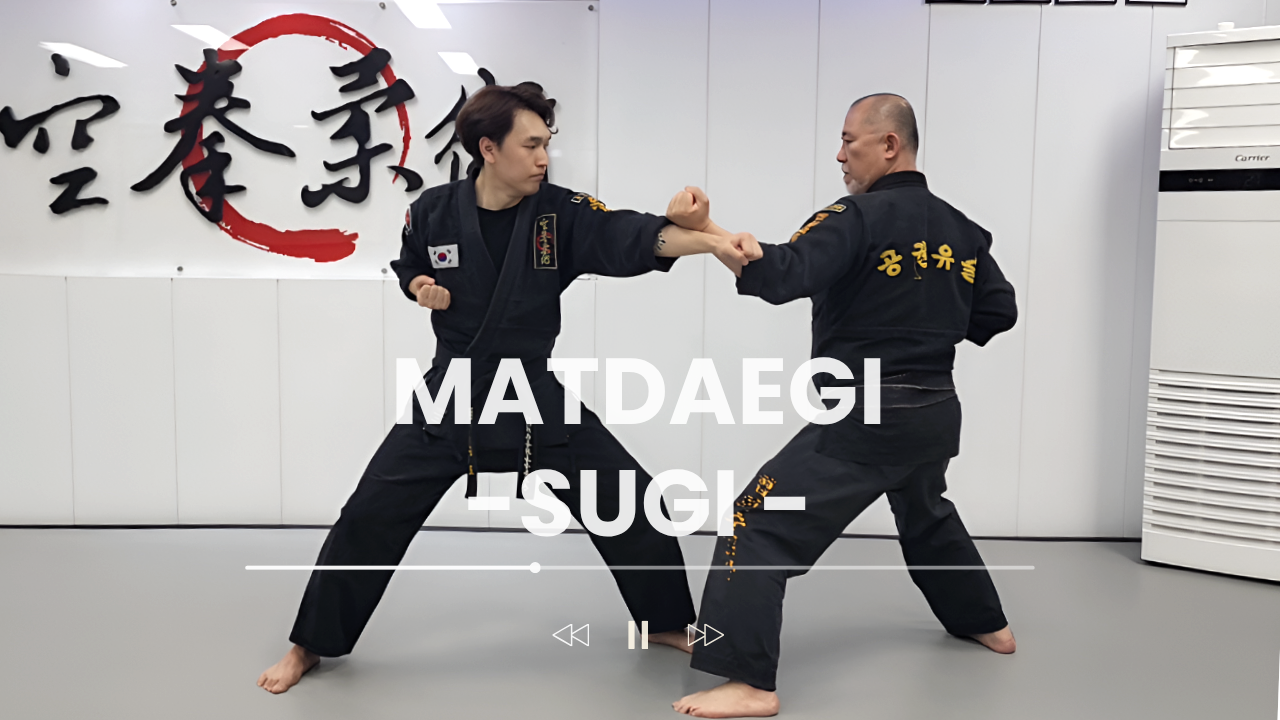
Matdaegi - Sugi (맞대기 수기)
: Striking Hands
[Access Period & Subscription Notice]
-
This product is a 1-Year Access Pass (Annual Subscription).
-
You will have full access to all course videos for exactly 365 days starting from your initial purchase date.
-
To ensure uninterrupted access after the 1-year period, your subscription will automatically renew and bill the annual fee each year on the same date.
-
If you do not wish to renew for the following year, you can cancel your subscription at any time through your My Account settings.
⚠️ Having trouble with Credit Card / PayPal payment? If your payment process fails, please check the following:
-
Cardholder Name Match: Ensure the name on the card matches your PayPal account holder name.
-
International/Online Payments: Verify that your card is authorized for online international/overseas transactions.
-
Security/Card Status: Check if your card has any security blocks, restrictions, or pending authorizations with your bank.
Key Focus: The harmony of Y in and Yang, understanding the meaning of technique, t im ing, distance, offense and defense, and cont inuous hand exchanges.
Matdaegi Sugi is structured according to the pr inciple of harmony between Y in and Yang. Its hand techniques are divided into Eumsu (陰手), the Y in sequence, and Yangsu (陽手), the Yang sequence. One pract i t ioner performs Eumsu whi le the other performs Yangsu, al low ing the two sequences to meet and funct ion together as one cont inuous exchange.
When pract iced alone, a movement may not immediately reveal i ts purpose. However , when two pract i t ioners face each other and perform the corresponding Y in and Yang sequences together , the meaning of each movement becomes clear . An attack meets i ts defense, a defense creates the opportuni ty for a counterattack, and each technique f i ts natural ly w i th the movement of the partner .
Through this interact ion, Y in and Yang are no longer abstract phi losophical ideas. They become visible and tangible through the exchange between two pract i t ioners. Each person comes to understand not only how a technique is performed, but also why i t exists, what i t responds to, and how i t connects to the next movement .
This is one of the essent ial pr inciples of Matdaegi : technique is understood through relat ionship. Offense gives meaning to defense, defense gives r ise to counterattack, and each movement exists in relat ion to the movement that meets i t .
Matdaegi also develops an intui t ive understanding of Ganhap (間合) , the pr inciple of proper distance and spat ial relat ionship between pract i t ioners. In Gongkwon Yusul , kicking, hand techniques, throws, and joint locks can ar ise w i thin the same cont inuous range of engagement . As pract i t ioners move between these methods w i thout breaking the exchange, they natural ly learn how distance changes and how the appropr iate technique changes w i th i t .
Through repeated partner pract ice, Ganhap is not learned merely as a measured distance. It is gradual ly perceived through the body as a l iving relat ionship of distance, t im ing, posi t ion, and movement .
Matdaegi Sugi therefore teaches more than hand techniques. Through the harmony of Y in and Yang and the pr inciple of Ganhap, pract i t ioners discover the purpose behind each movement and learn how offense and defense, distance and t im ing, and one technique and the next are connected w i thin the cont inuous f low of Gongkwon Yusul .
맞대기 수기 핵심 수련: 음양의 조화, 기술의 의미에 대한 이해, 타이밍과 거리, 공방의 연결, 그리고 간합의 이치 맞대기 수기는 음양의 조화라는 이치에 따라 구성되어 있습니다. 맞대기 수기에는 음수(陰手)와 양수(陽手)가 있으며, 한 사람은 음수를 수련하고 다른 한 사람은 양수를 수련합니다. 서로 다른 두 개의 수련이 마주했을 때 하나의 연속된 공방으로 완성되도록 구성되어 있습니다.
혼자 동작을 수련할 때는 자신이 하고 있는 동작이 무엇을 의미하는지 바로 이해하기 어려울 수 있습니다. 그러나 두 사람이 서로 마주 보고 음수와 양수를 함께 시연하면 각각의 동작이 서로 정확하게 맞물립니다. 한 사람의 공격은 다른 사람의 방어와 만나고, 방어는 다시 반격의 기회를 만들며, 각각의 기술은 상대의 움직임과 자연스럽게 연결됩니다.
이 과정에서 음과 양은 추상적인 철학에 머무르지 않습니다. 두 사람의 공방을 통해 눈으로 확인하고 몸으로 경험할 수 있는 원리가 됩니다. 수련자는 기술을 어떻게 사용하는가뿐만 아니라 왜 이러한 동작이 존재하는지, 무엇에 대응하는 기술인지, 그리고 다음 움직임과 어떻게 연결되는지를 자연스럽게 이해하게 됩니다.
이것이 맞대기가 지닌 중요한 원리 가운데 하나입니다. 기술은 서로의 관계 속에서 그 의미가 드러납니다. 공격이 있기 때문에 방어의 의미가 생기고, 방어는 다시 반격을 만들어내며, 하나의 움직임은 그것과 마주하는 또 다른 움직임을 통해 비로소 자신의 쓰임을 드러냅니다.
또한 맞대기는 간합(間合)의 이치를 몸으로 터득하게 합니다. 공권유술에서는 같은 공방의 흐름 안에서 발차기, 수기, 메치기, 꺾기가 연속적으로 이루어집니다. 수련자는 이러한 기술들을 끊김 없이 연결하면서 거리가 어떻게 변화하는지, 그리고 그 거리의 변화에 따라 어떤 기술이 적합한지를 자연스럽게 익히게 됩니다.
따라서 간합은 단순히 상대와의 거리를 숫자로 측정하여 배우는 개념이 아닙니다. 반복적인 맞대기 수련을 통해 거리와 타이밍, 위치와 움직임의 관계를 몸으로 느끼고 판단하는 감각으로 발전합니다.
맞대기 수기는 손기술만을 익히는 과정이 아닙니다. 음양의 조화와 간합의 이치를 통해 각각의 동작이 존재하는 이유를 이해하고, 공격과 방어, 거리와 타이밍, 하나의 기술과 다음 기술이 공권유술의 연속적인 흐름 속에서 어떻게 하나로 연결되는지를 몸으로 깨닫는 수련입니다.