
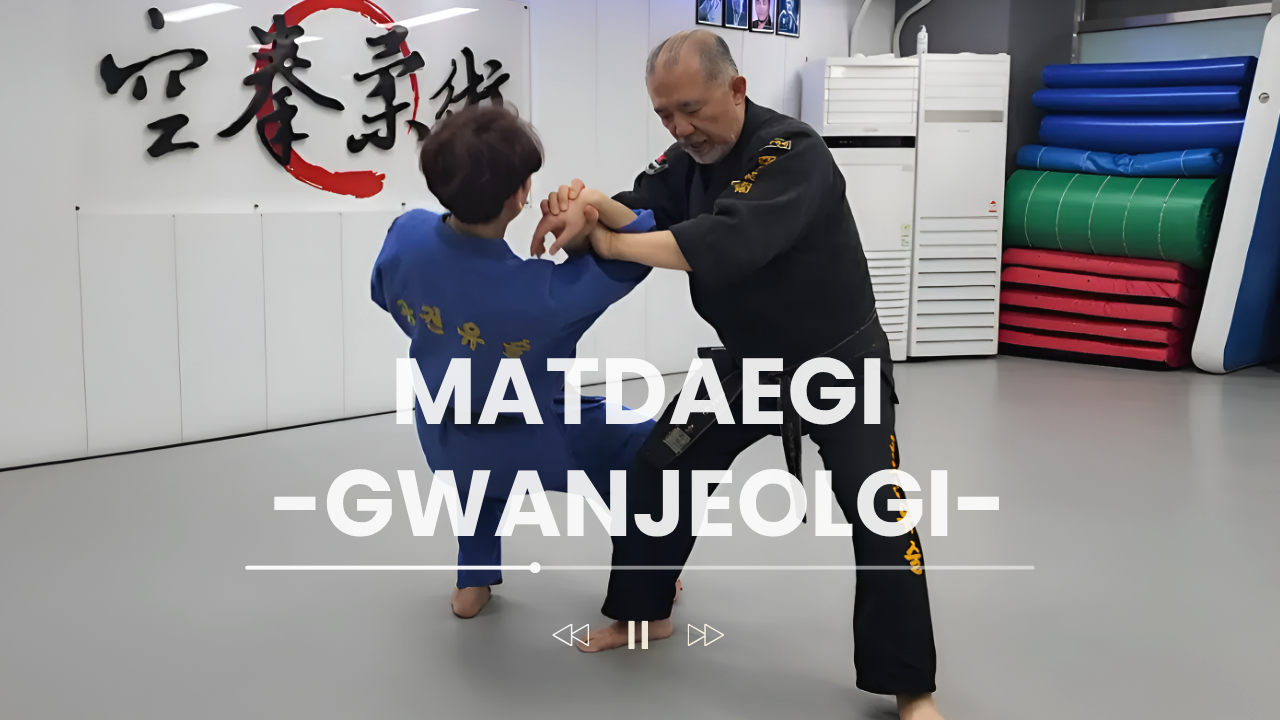
Matdaegi - Gwanjeolgi (맞대기 관절기)
: Matched Joint Locks
[Access Period & Subscription Notice]
-
This product is a 1-Year Access Pass (Annual Subscription).
-
You will have full access to all course videos for exactly 365 days starting from your initial purchase date.
-
To ensure uninterrupted access after the 1-year period, your subscription will automatically renew and bill the annual fee each year on the same date.
-
If you do not wish to renew for the following year, you can cancel your subscription at any time through your My Account settings.
⚠️ Having trouble with Credit Card / PayPal payment? If your payment process fails, please check the following:
-
Cardholder Name Match: Ensure the name on the card matches your PayPal account holder name.
-
International/Online Payments: Verify that your card is authorized for online international/overseas transactions.
-
Security/Card Status: Check if your card has any security blocks, restrictions, or pending authorizations with your bank.
Key Focus: Matdaegi distance, t im ing, sudden joint entry, precision control , and Ganhap.
Matdaegi Gwanjeolgi is an advanced joint- locking system pract iced at a speci f ic engagement distance. Two pract i t ioners extend thei r arms toward each other unt i l the backs of thei r hands l ight ly meet . This posi t ion establ ishes the start ing distance for Matdaegi Gwanjeolgi .
Many joint- locking techniques begin as a response to an establ ished gr ip, such as when an opponent grabs the wr ist , arm , or clothing. Matdaegi Gwanjeolgi takes a di fferent approach. The pract i t ioner ini t iates the joint lock before the opponent establ ishes a gr ip, captur ing and control l ing the joint di rect ly from the Matdaegi posi t ion.
This requi res precise t im ing, sensi t ivi ty, speed, angle, and control . The pract i t ioner learns to recognize the opening, enter immediately, and connect the opponent’s arm into a joint lock in one cont inuous movement .
This proact ive method of joint control is one of the dist inct ive character ist ics of Gongkwon Yusul . It develops a more advanced and pract ical abi l i ty to apply joint- locking techniques dur ing an act ive exchange rather than wai t ing for a speci f ic gr ip to occur .
Through Matdaegi Gwanjeolgi , pract i t ioners also develop a ref ined understanding of Ganhap (間合) , learning to recognize the exact distance and moment in which a joint can be captured and control led.
핵심 수련: 맞대기 거리, 타이밍, 기습적인 관절 진입, 정밀한 제어, 간합
맞대기 관절기는 두 사람이 서로 손을 뻗어 상대의 손등과 자신의 손등이 가볍게 맞닿는 거리에서 시작하는 고급 관절기 수련법입니다. 이 거리가 맞대기 관절기의 기본적인 공방 거리가 됩니다.
일반적인 관절기는 상대가 손목이나 팔, 옷깃 등을 잡은 상태에서 그에 대응하여 기술을 거는 경우가 많습니다. 맞대기 관절기는 상대가 나를 잡기 전에 맞대기 상태에서 먼저 상대의 관절을 포착하고 직접 꺾기와 제어로 연결합니다.
이를 위해서는 정확한 타이밍과 감각, 속도, 각도, 제어 능력이 필요합니다. 상대의 빈틈이 만들어지는 순간을 포착하고 즉시 진입하여 하나의 연속된 움직임으로 상대의 팔을 관절기에 연결합니다.
이러한 선제적이고 기습적인 관절 제어 방식은 공권유술 관절기의 특징 가운데 하나입니다. 상대가 특정한 방법으로 나를 잡아주기를 기다리지 않고 실제 공방이 이루어지는 과정에서 관절기를 적용하는 더욱 실전적이고 고급화된 기술 능력을 발전시킵니다.
맞대기 관절기 수련을 통해 수련자는 관절을 포착하고 제어할 수 있는 정확한 거리와 순간을 몸으로 인식하며, 간합(間合)의 이치를 더욱 정교하게 체득하게 됩니다.